
The Problem With Asking Employees to “Take Ownership”
And then punishing their initiative
Hi, fellow future and current Data Leaders; Ben here 👋
As companies continue to try to figure out where AI can be impactful, many employees are constantly trying to upskill and skate to where the puck is going. In today’s article, I wanted to talk about agency and ownership and what I’ve seen leaders actually mean when they say they want it.
Before diving into that, I wanted to talk a bit about Estuary, a platform I’ve set-up for several clients and also advise. If you’re looking to ingest data from Postgres, Salesforce, or +200 other source into Snowflake or another data platform, Estuary makes that easy and allows you to switch between real-time and batch jobs easily.
That means your team can spend less time maintaining ingestion scripts and more time actually using the data. If you’re looking to simplify how your team moves data, check them out.
Now let’s jump into the article!
It’s been said that agency is one of the skills you’ll need in the era of AI.
But as with anything, there are pros and cons.
Having a bunch of employees doing whatever they think is the right thing to do may not lead to positive outcomes. They might not all be rowing in the same direction. Chaos will quickly ensue.
Two teams might start producing duplicate work. A new hire or junior employee might take on what seems like urgent work but doesn’t align with the business’s overall strategy.
Sure, you can hear stories of employees creating a new product that happens to save the business by accident. For example:
Post-it Notes at 3M
Gmail at Google
PlayStation at Sony
But I do believe these are also companies that benefit from R&D type projects. If you’re a software or data engineer at a more traditional company, you’ll likely not be rewarded for a new product or idea you come up with.
Especially if it doesn’t align with your company’s core competencies. That is to say, if you’re building a social media site but your company is a healthcare provider…what are you doing? (Someone somewhere is going to give me an example where this worked.)
So what do leaders really mean when they say they want agency?
Agency Still Needs Direction
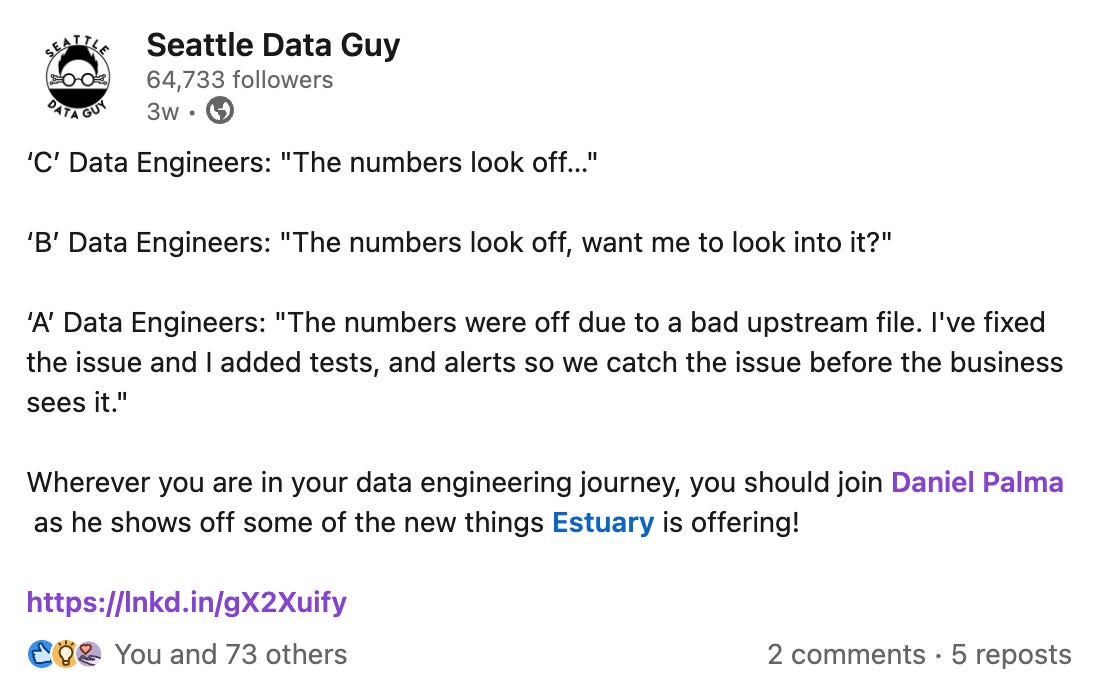
Recently, I posted on the Seattle Data Guy LinkedIn talking about different levels of engineers, and one commenter responded with:
“Advice to junior data engineers: never, ever try to be the 3rd guy(the individual with the most agency). Why? Because the next thing will be that their boss/senior will ask back: “Why? That was a low-priority problem, and we had our high-priority tasks for the sprint you ignored. “
There is some truth to this.
A junior engineer probably shouldn’t disappear for a week to solve a problem nobody agreed was important. Especially when there are already higher-priority problems sitting in front of them.
But I disagree with the word never. Perhaps they only meant it in terms of the example I gave above.
But really…never?
Never look for problems other employees might have missed because they are so deep in the weeds or in the company’s politics that they can’t even see?
Never propose something outside of your assigned task list?
Never take initiative unless someone explicitly tells you to?
That’s a great way to make sure someone never develops the judgment required to become senior. Had they said, “Don’t just take on problems without talking to your manager first,” I could get behind it. That makes sense, at least early in your career as you’re learning what is important and what isn’t. Early on, the nuance might be that simple.
Should you come up with your own ideas and see what the more senior members of your team think?
Yes!
Agency in the context of a company doesn’t mean doing whatever you want. When you apply that agency in terms of a company you should be considering:
What are our companies overall goals?
Is someone already working on it?
What am I not seeing because I don’t have the full context?
Can I validate the idea before spending a significant amount of time on it?
And I’m sure I’ll get pushback even here.
I’ve heard plenty of people say, “Just do your job and deliver what the business needs.”
Which is exactly why I think many businesses struggle to find the point where technology and the business can actually work together.
But if employees at all levels, never try to challenge themselves and look for new ways to apply their skills and combine them with business needs. Then all you will end up with is task takers waiting patiently to be told what to do.
Maybe that’s all companies really want?
You Can’t Ask for Ownership and Punish Initiative
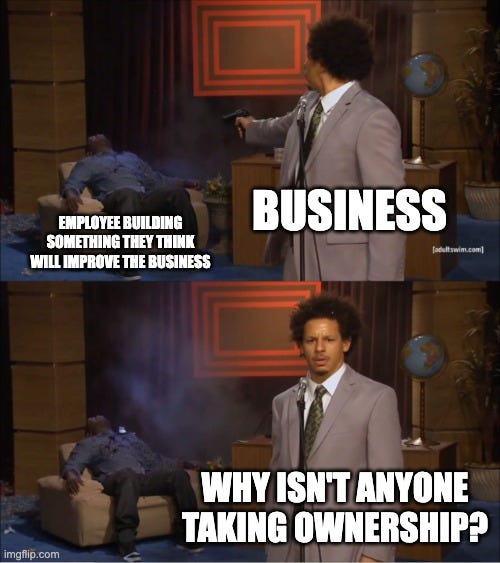
It’s not great having a junior engineer go off and build something that is unneeded. However, I’d say it’s worse to train up an engineer who can never think for themselves.
Is it easier to ensure your goals, as a leader, get done?
Yes.
After all, it takes far more effort to pause and take time out of your day and explain to a junior engineer why that task shouldn’t have gotten done or maybe provide context of what your larger vision is.
It also creates a culture where people will never try anything. Why?
I’ve seen seniors get broken down by cultures like this, where they try to bring up good ideas but get chastised for even trying. Then suddenly I am talking to business leaders who wonder why their data and software teams don’t take ownership.
Why should they?
They’ll never be rewarded, only punished.
So yes, you want everyone rowing in a similar direction. But if you want people to take ownership, you’ll have to give a little trust that they are also smart individuals who maybe just need some minor course corrections.
Many Leaders Only Think They Want Agency
Now, taking a step back, after working with a lot of leaders, I think I’ve realized what many of them mean when they say they want agency.
They mean they want people who will own workflows the way the leader wants them to own them. They want more versions of themselves. People who will just do exactly what needs to get done when it has to be, but only if it aligns with the leader’s thinking. Which isn’t agency.
What people really want is what you could say is independent execution within a predefined set of expectations.
And there’s nothing inherently wrong with that. But it’s different from giving someone true agency and in turn having to put in the extra effort to help said employees and engineers understand the big picture.
That takes extra work. It also means allowing your team to make mistakes as they are learning to get a sense for what needs to get done.
It really is just easier to say, “only do what I tell you, and take ownership of what I tell you”.
My Advice
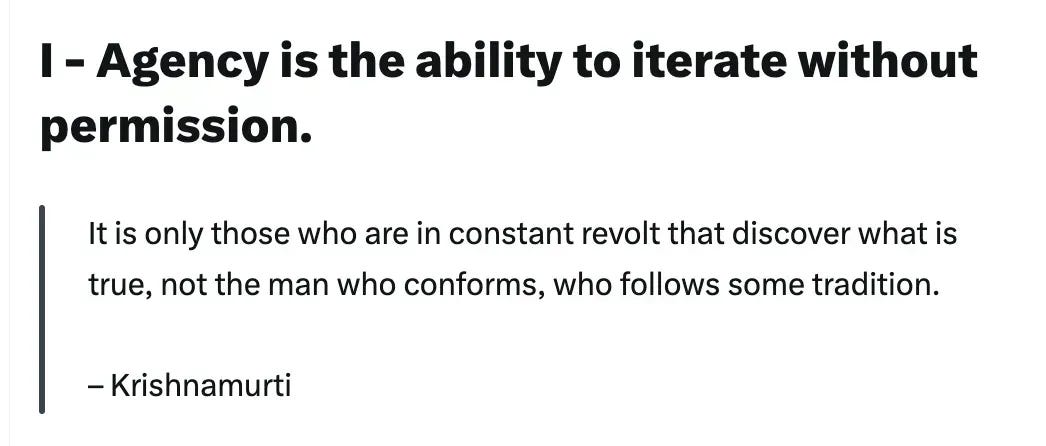
In almost every role I’ve ever had I took on ideas I believed both aligned with the business and helped me grow…but no one assigned me.
When I was a prep cook at at a restaurant in Seattle, I was able to get a dish on the menu because I saw that we were throwing rabbit livers away. So I started coming in early, testing out a rabbit liver mousse until it was good enough to be placed on the menu.
When I got my first data engineering role I created a system to fully automate data ingestion for a key data product because at the time we were using a combination of automated processes and manual commands to ingest data end-to-end.
So reading the word “never” was like nails on a chalkboard.
Here is my advice if you’re looking to grow and practice taking ownership and having more agency.
You still have to get your work done - Of course your manager will be upset if you don’t complete the work they said needs to get done. So in no way am I saying you should abandon your responsibilities to take on something when you’re uncertain of the value.
Establish your credibility first - If you’re a junior, people want to see that you can consistently handle the work already in front of you. The more trust you build, the more room you’ll usually get to explore your own ideas. I think good leaders want to keep employees energized and excited.
Validate the idea before going too far - If you’re still early in your career, go and chat with more senior members on your team when you have an idea. Sometimes a quick conversation with your manager or a senior engineer is enough to find out whether the idea you have is valuable or if you’re missing context. Maybe your manager has a plan to solve the problem you think is important. Maybe they are waiting for it to become a big enough problem that they can actually get budget to fix it rather than continually putting Band-Aids on it.
Try to connect your ideas to the actual business- I’ve built a few ideas that were driven more by “I think this would be interesting to build” instead of “This would help the business”. You’ll hopefully quickly realize the difference. If not on your own, because someone will let you know. So take the time to actually learn what the business needs and then connect that to your ideas.
Don’t just use agency as an excuse to escape the work you’re supposed to be doing - The goal isn’t to find more interesting work while ignoring everything else. It’s tempting…I know. But just because you see work that could be done, doesn’t mean you should drop everything you’re doing. And if you do, expect a lot of pushback.
Final Thoughts
I do find it interesting that many individuals who speak about agency usually are referring to it in a business context only. Because that, of course, is the only part of life that matters.
Perhaps that’s a musing for a future article.
But purely from a business context I do often find that many companies don’t reward agency.
At best you’ll get more responsibility and a small raise. In many cases, you’ll likely be criticized for not going through the correct layers of bureaucracy even if it could lead to some level of benefit for the business.
And yet those same companies will complain that employees don’t take enough ownership.
I don’t think the answer is for every employee to start freelancing inside the company and working on whatever they find interesting. That would be chaos.
But the answer also can’t be to train people to wait for instructions.
As always, thanks for reading!
Articles Worth Reading
There are thousands of new articles posted daily all over the web! I have spent a lot of time sifting through some of these articles as well as TechCrunch and companies tech blog and wanted to share some of my favorites!
Forward Deployed Engineering Is About To Get Diluted
Microsoft recently announced a $2.5 billion investment for an army. An army of 6,000 FDEs.
AWS also announced a $1 billion investment into a new Forward Deployed Engineering organization.
Both are joining the hype cycle Palantir helped start, and now every AI startup seems to want in.
Microsoft did try to distance themselves by stating:
This goes beyond what has been labeled as Forward Deployed Engineering (FDE) and will be the largest, most capable, outcome-driven engineering organization in the industry. - Microsoft
Now by saying that, they are really only putting a spotlight on the FDE term and what it is. They just want to make it sound cooler.
Like the Zune, it’ll be like the iPod, but better!
Here is my bold prediction.
Inside the Data Interview: Tim Frazer (Director of Data & Analytics at Trust & Will)
By Alejandro Rojas López and Tim Frazer
Today I serve as a Director of Data Engineering & Analytics at trustandwill.com a series C startup in the USA. We I am responsible for sending out thousands of reports for direct to consumer, and business to business reporting, data governance, security, data platform, BI, AI where it makes sense, and all the stuff that entails for a 100+ person startup in a legal tech field.
I hold no degrees as I was homeschooled growing up, so I backed into data through an business analyst job at a grocery store after stocking selves for years, taught myself SQL because a problem in front of me needed it, then Python, then everything after. More than ten years on, I’ve built data teams from zero to teams of teams, stood up data lakes and lakehouses from scratch, ran data at a behaviour-change startup in NYC, did freelance the consulting stint full time, and interviewed and mentored across hundreds of candidates for engineering, analytics, and data product roles.
End Of Day 223
Thanks for checking out our community. We put out 2-5 Newsletters a month discussing data, tech, and start-ups.
If you enjoyed it, consider liking, sharing and helping this newsletter grow.
Thanks for the mention - just doing a nerd brain dump
Thanks for the mention! It was a really interesting interview with Tim